

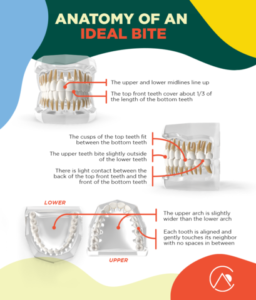

The Anatomy of an Ideal Bite

Cronin & Czarnik Orthodontics • October 29, 2022

You probably have a good idea of what a perfect smile looks like. But you might be less familiar with what an ideal bite looks like. In fact, patients are sometimes surprised to learn they even have a bite problem at all. To help give you some clarity, I’ll be covering everything you need to know about your bite.

What Does “Bite” Mean in Orthodontics?


Your bite, or dental occlusion, refers to the relationship between the teeth in the upper jaw and the teeth in the lower jaw and how they fit together. 

With a normal, or ideal, bite, the top and bottom teeth meet in a comfortable way that distributes bite forces properly and promotes harmony in the entire chewing system (i.e., teeth, gums, jaws, chewing muscles, jaw joint, etc.). 

What Does an Ideal Bite Look Like?


While visiting an orthodontist is the only way to determine whether or not your bite is aligned, you can get a general idea by looking in the mirror. 

If you bring your upper and lower teeth together, when viewed from the front:

  • The edges of the top teeth should be parallel to the bottom lip, following its curve
  • The top front teeth should cover about ⅓ of the length of the lower front teeth
  • The upper midline (the line between the top front teeth) should be in the center of the upper lip. The upper and lower midlines should also line up.

When viewed from the side:

  • All of the upper teeth should bite slightly outside of the lower teeth
  • The cusps, or points, of the top teeth should fit between two bottom teeth
  • The back of the top front teeth should have light contact with the front of the bottom teeth


If you were to open wide and look at your entire upper and lower arch:

  • The teeth in each arch should follow an even curve
  • Each tooth should gently touch its neighbor without overlapping or having spaces in between
  • The upper arch should be a tiny bit wider than the lower arch

Why is Having a Healthy Bite Important?


When you have crooked teeth or a discrepancy in jaw size that interferes with the bite, it can cause a number of complications. 

Having a healthy bite , on the other hand:

  • Makes teeth easier to clean, reducing your risk of tooth decay and gum disease
  • Distributes chewing forces correctly, helping you avoid breakage and uneven enamel wear
  • Allows you to bite into foods and chew properly 
  • Makes teeth less susceptible to injury (protruding teeth are in harm’s way)
  • Encourages facial symmetry and improves your appearance
  • Prevents undue stress on the temporomandibular joint (TMJ) and chewing muscles, alleviating TMJ pain, facial pain and headaches
  • May help with teeth grinding and clenching (bruxism)
  • Can promote a healthy airway and proper breathing
  • Lets you speak clearly
  • Keeps the jawbone healthy and strong

What is Malocclusion?


Now that you know what an ideal bite looks like, let’s talk about the opposite: malocclusion. Malocclusion translates literally to “bad bite.” When you have malocclusion, whether due to the teeth, the jaw or both, the upper and lower arches don’t come together properly. 

While there are classes and divisions of malocclusion, for the purpose of this blog post, I’ll just give you the basics. The most common types of malocclusion include:

  • Crowding – Crowding is when the jaw is too small to accommodate all of the teeth. As the teeth try to squeeze in, they often overlap, twist or get blocked out of line. This makes keeping up with proper oral hygiene difficult. It can also cause uneven wear on the teeth.
  • Spacing – Spacing is when there are gaps between two or more teeth. Gaps tend to trap food debris and plaque, compromise gum health and can cause bone loss.
  • Excessive Overbite (Deep Bite) – As you saw with an ideal bite, a little bit of an overbite is a good thing. However, when the top front teeth cover too much of the bottom teeth, you’re said to have an excessive overbite, or deep bite. In extreme cases, the bottom teeth can bite into the roof of the mouth causing trauma and wear to both the teeth and gums.
  • Underbite – When a patient has an underbite, their lower jaw and teeth are positioned in front of the upper jaw and teeth. The lower jaw can trap the upper jaw, preventing upper jaw growth. Since it’s usually a skeletal issue, early intervention can be the key to addressing an underbite without having to resort to corrective jaw surgery.
  • Overjet – People often use overjet and overbite interchangeably but they’re actually two different conditions. Overjet is a measure of horizontal distance between the top and bottom front teeth, while overbite measures the vertical distance. When a patient has overjet teeth, the front teeth protrude, or stick out, too far in front of the bottom teeth.
  • Crossbite – A crossbite is when one or more bottom teeth sit in front of the top teeth. If the teeth in the back of the mouth are involved, it’s called a posterior crossbite, or back crossbite. When the teeth towards the front of the mouth are in crossbite, it’s called an anterior crossbite, or front crossbite. Similar to an underbite, the lower jaw can sometimes trap the upper jaw and lead to abnormal or asymmetric jaw growth.
  • Open Bite – If you have an open bite, your top front teeth don’t overlap your bottom teeth at all. You may even have a visible opening between the upper and lower teeth when the back teeth are touching. This makes it hard to bite and chew.

How are Bite Problems Diagnosed?


As board-certified orthodontists, Dr. Cronin and I have
extensive training in diagnosing even subtle bite issues. To do this, we take diagnostic records, such as x-rays and photographs, and perform an exam. 

Some of the things we look for include:

  • How your upper jaw and lower jaw are balanced to one another and your skull
  • How your teeth are positioned in relation to your lips and facial features
  • Whether you have missing or extra teeth
  • Whether or not the midlines are centered
  • How much of the lower front teeth are visible when the jaws are closed
  • The width of the upper arch in comparison with the lower arch
  • How the cusps of the back top teeth fit in between the lower teeth
  • Whether the top front teeth come into contact with the bottom front teeth
  • Whether the teeth in each arch are aligned and touching one another without overlapping or having spaces in between them
  • Whether your teeth are too small or perfectly sized

How is a Bad Bite Treated?


If you don’t have an ideal bite, the good news is, it can be fixed! While it will depend on your unique smile and the severity of your case, treatment options could include:

  • Phase 1 Orthodontic Treatment – The American Association of Orthodontists recommends kids have their first orthodontist visit no later than age 7. At this age, most kids have their first permanent molars and the back of the bite is established. 

The majority of kids won’t need intervention this young, but there are some skeletal problems that respond best to treatment between the ages of 7 and 10, before peak growth is complete, such as an underbite, some posterior crossbites or an emerging, severe overbite. 

Early interceptive treatment, or phase 1 treatment , allows Dr. Cronin and I to use an orthodontic appliance, like a rapid palatal expander, to guide jaw growth and make room for the permanent teeth to erupt properly. Then, after a resting period, kids will usually start phase 2 treatment with braces or Invisalign Teen once all of their permanent teeth are in. 

This approach can make the second phase of treatment in the teenage years much easier and more affordable. It can also help kids avoid the need for corrective jaw surgery or extractions later in life. 

  • Braces Braces are effective for treating a range of bite problems in patients of all ages. The system of brackets and wires exerts steady, gentle pressure that shifts the teeth into place. 

That said, braces shift the teeth in each arch independently of one another. To create an ideal bite, a connective force is often needed to bring the upper and lower arches into alignment. For this, auxiliaries like rubber bands can be used in conjunction with your braces. 

  • Invisalign – Invisalign used to only be reserved for mild cases like small gaps between the teeth or a little bit of crowding. However, these days, under the care of an experienced orthodontist, we can use Invisalign aligners to fix nearly every problem braces can. 

At Cronin & Czarnik Orthodontics, we’re a leading North Denver Invisalign provider. I also completed The Aligner Fellowship, a program open to top Invisalign providers, where I gained expertise in complex aligner techniques. 

All of this means we have the proficiency and case experience to use Invisalign to fix most bite issues. We may pair your aligners with Invisalign attachments and/or rubber bands to get that necessary connective force to bring your bite into alignment while the aligners straighten your teeth. 

  • Surgical Orthodontics – Advances in orthodontics allow us to treat many adult patients without jaw surgery. Occasionally, however, such as in the case of a severe underbite, corrective jaw surgery combined with orthodontic treatment will achieve the best results in adult patients who are done growing. In these rare cases, we work closely with the oral surgeon to coordinate care and achieve the perfect balance of function and aesthetics.
  • Craniofacial Orthodontics-  WORK ON THE CLEFT TEAM AND TREAT CLEFT PTS

Let an Orthodontist in Westminster, CO Evaluate Your Bite

Want to know if you have an ideal bite? Schedule a complimentary consultation at Cronin & Czarnik Orthodontics in Westminster today! During this initial visit, Dr. Cronin or I will look at your diagnostic records and complete a comprehensive exam. 

If we do diagnose you with malocclusion, we’ll be able to provide personalized treatment recommendations to help you achieve straight teeth and an aligned bite.

Share this article

Recent Posts

By Cronin & Czarnik Orthodontics July 9, 2026
Learn why wearing your retainer for life helps prevent teeth from shifting after braces or Invisalign. Protect your smile with expert orthodontic advice.
June 19, 2026
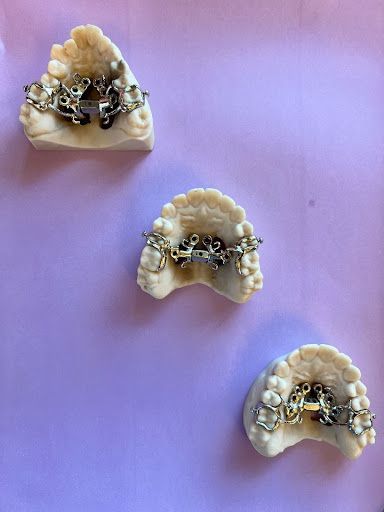
Looking Beyond the Latest Acronym If you've been researching adult palate expansion online, you've probably come across a confusing list of terms: MARPE MASPE MSE Custom MARPE FME Hybrid Expanders Bone-Borne Expanders It can seem like every few months there is another acronym claiming to be the "new" or "better" way to expand the upper jaw. So what's the difference? The answer is surprisingly simple: Most of these names describe very similar concepts, and often the differences are in appliance design or how the appliance is activated—not an entirely new treatment philosophy. At Cronin & Czarnik Orthodontics, we've been providing skeletal expansion for years. More importantly, we were early adopters of slow activation protocols long before the term "MASPE" became popular. Our philosophy has always been to treat the biology—not the buzzwords. What is MARPE? MARPE stands for Mini-Implant Assisted Rapid Palatal Expansion . Despite the word "rapid," MARPE simply refers to an expander that is supported by temporary mini-implants (TADs) placed in the palate. Unlike traditional expanders that rely mostly on the teeth, MARPE transfers much of the expansion force directly into the upper jaw bone, making it possible to successfully expand many older teenagers and adults who have completed growth. MARPE has transformed orthodontics by allowing many patients to avoid more invasive surgical procedures while achieving true skeletal expansion. Then What is MASPE? MASPE generally stands for Mini-Implant Assisted Slow Palatal Expansion . Here's the important part: MASPE is not a completely different appliance. In most situations, it is simply a MARPE appliance that is activated differently. Instead of prescribing aggressive daily turns, the appliance is activated much more gradually, allowing the surrounding bone, sutures, and facial structures additional time to adapt. In other words: Same appliance. Different protocol. This distinction has become increasingly recognized because clinicians have learned that many adult patients respond better to slower, more biologic expansion than the traditional "rapid" approach. We Were Using Slow Expansion Before It Had a Name One of the exciting parts of orthodontics is that techniques continue to evolve. Sometimes the science changes. Sometimes the terminology changes even faster. Long before the phrase "MASPE" became common, our office had already transitioned toward slower, more controlled activation for many patients. Why? Because our clinical experience—and the growing body of research—showed that every patient responds differently. Rather than forcing every patient into the same schedule, we individualized treatment based on: Age Bone maturity Suture response Comfort CBCT imaging Overall treatment goals Airway considerations That philosophy continues today. Why We Prefer a Slow, Customized Approach Every patient's biology is different. Some patients respond quickly. Others require more time. Some benefit from stretching protocols before active expansion. Others progress with very minimal activation. Our goal isn't simply to make the screw turn. Our goal is to achieve stable skeletal expansion while minimizing unnecessary stress on the teeth, gums, and surrounding bone. A slower protocol may offer advantages such as: Improved patient comfort Better control of tooth movement Reduced unwanted dental tipping More gradual adaptation of surrounding tissues More predictable biologic response There is no single activation schedule that works for every patient. Why Are There So Many Different Names? Orthodontics has always been full of evolving terminology. Over the past several years you've likely seen names such as: MARPE MASPE MSE FME Custom MARPE Bone-Borne Expansion Hybrid Expansion Each represents a variation in appliance design, engineering, or activation philosophy. Sometimes these innovations are meaningful. Sometimes they're primarily different ways of describing similar concepts. The most important question isn't: "Which acronym is best?" Instead ask: "Does my orthodontist have experience diagnosing the right patients and customizing treatment for my anatomy?" That question has a much bigger impact on success than the letters attached to the appliance. Expansion is About More Than Creating Space Many people assume expansion is only used to make room for crowded teeth. While that is certainly one benefit, widening a narrow upper jaw may also help: Correct crossbites Improve smile width Create room for proper tongue posture Improve bite function Support healthier nasal breathing in appropriately selected patients Potentially reduce the need for tooth extractions Every patient is unique, which is why a comprehensive evaluation—including digital scans and 3D CBCT imaging—is essential before recommending treatment. Experience Matters Adult skeletal expansion has become increasingly popular over the past decade. As with any advanced orthodontic procedure, success depends on much more than purchasing a particular appliance. It requires: Careful diagnosis Detailed 3D treatment planning Appropriate appliance selection Customized activation schedules Close monitoring throughout treatment Knowing when to speed up—or slow down—the process At Cronin & Czarnik Orthodontics, skeletal expansion is one of our areas of expertise. We've been helping both children and adults with airway-focused orthodontics and customized MARPE treatment for years, and we continue to refine our protocols as new evidence emerges. Rather than chasing the newest acronym, we focus on what has always mattered most: Providing personalized, biologically respectful treatment that gives each patient the best opportunity for a healthy, stable, and lasting result. Wondering if You're a Candidate? Whether you've heard the terms MARPE, MASPE, MSE, or another variation, the first step is the same: a comprehensive evaluation. At Cronin & Czarnik Orthodontics, we'll determine whether skeletal expansion is appropriate for you, explain your options, and develop a customized treatment plan based on your unique anatomy—not the latest trend. Schedule your complimentary consultation today to learn whether MARPE or another expansion approach is right for you.
Why Age 7 Is Oldschool Thinking: The Case for Earlier Orthodontic Evaluations
By Cronin & Czarnik Orthdontics April 10, 2026
At Cronin & Czarnik Orthodontics, we often hear the same question from parents: “When should my child first see an orthodontist?” The American Association of Orthodontists recommends that children have their first...
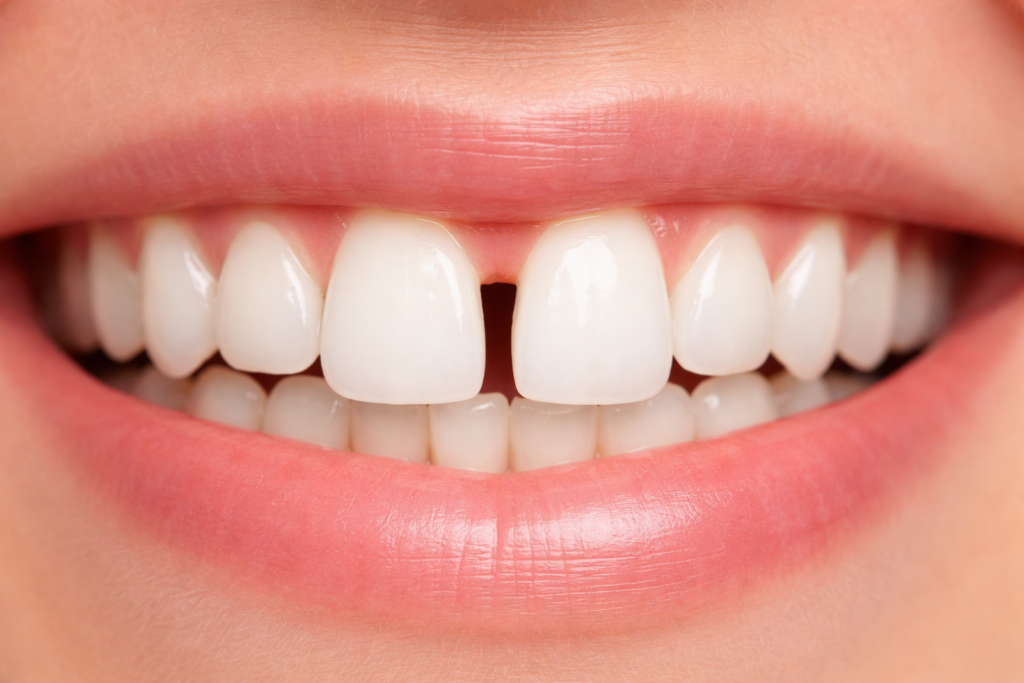
Close-up of a smiling mouth showing white teeth and pink lips
By Cronin & Czarnik Orthodontics March 19, 2026
At Cronin & Czarnik Orthodontics, we’ve built a reputation as one of Colorado’s leading providers of advanced airway-focused orthodontic treatments—especially MARPE (Miniscrew-Assisted Rapid Palatal Expansion). One of the most common...
Ask Me Anything About My MARPE Treatment
By Cronin & Czarnik Orthodontics February 16, 2026
An interview with Julie, age 39 — Cronin & Czarnik Orthodontics patient At Cronin & Czarnik Orthodontics, we believe the most powerful way to understand treatment is to hear directly...
MARPE: The Greatest New Treatment in Orthodontics
By Cronin & Czarnik Orthodontics January 7, 2026
Orthodontics is evolving—and at Cronin & Czarnik Orthodontics, we are proud to be at the forefront of one of the most impactful advances the profession has seen in